
Narrative Category: Quantum Mechanics
Cosmology Author: José Geraldo de Souza Alves
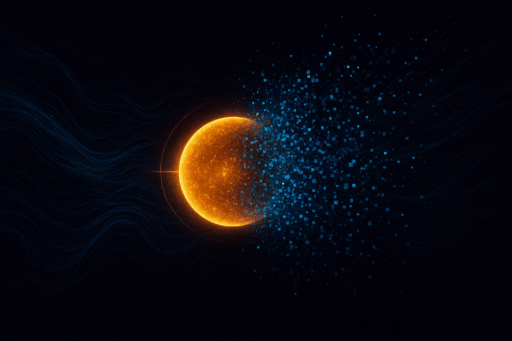
Decoherence is not merely a technical glitch in human laboratories—it is the great divider between the real and the apparent. In the pursuit of stable quantum computing, we often view a qubit losing coherence as an “error.” However, a deeper analysis suggests a different truth: when a qubit decoheres, it does not fail; it reveals that the local Universe has successfully imposed its own history upon the quantum state.
At the Tri Imun Research Initiative, we investigate the four primary vectors of contamination that force this collapse: mechanical vibrations, thermal fluctuations, electromagnetic fields, and cosmic background noise. Each vector attempts to impose a distinct ‘narrative’ on the quantum state, forcing it to choose a single reality.
The Vulnerability of Human Architectures
Our current study analyzes the residual coherence rates of three dominant technologies, highlighting their specific susceptibilities:
1-Superconducting Qubits (Transmons): Highly sensitive to thermal variations, where the environment seeks to reach thermal equilibrium, destroying the quantum information.
2-Trapped Ion Qubits: While stable, they suffer from mechanical vibrations and electrostatic instability, acting as seismographs for the local environment.
3-Quantum Dots: Here, the enemy is internal—nuclear spin noise—where the material itself interacts with the qubit.
By comparing the dominant mechanisms of Relaxation (T1), Dephasing (T2), and unwanted environmental coupling, we begin to map how the universe filters probability into certainty.
Deep Decoherence and the $\Lambda$ Noise
We propose that decoherence is a universal process, not just a laboratory phenomenon. Every material structure—including biological life—is the result of quantum systems that have undergone millions of decoherence cycles until fixing a dominant probability.
The pivotal question driving our current research is: “When we manage to isolate almost everything, what remains?”
What remains is the noise of the space-time fabric itself. We hypothesize this as $\Lambda$ Noise (Lambda Noise). This marks the transition to what we call ‘Deep Decoherence’—where the qubit-environment interaction is no longer an error to be corrected, but an involuntary measurement of the Universe itself.
Connecting this to the Primordial Vortex Theory, we suggest that the harmonic stability provided by the A-C Field interaction is the only mechanism capable of ordering this fundamental noise, allowing for the coherent structures we observe in the cosmos today.
Conclusion: The Harmonic Path to Stability
Ultimately, the study of deep decoherence suggests that the “collapse” of the wave function is not a random accident, but a deterministic selection process driven by the informational density of the environment. The $\Lambda$ Noise we observe is likely the residual vibration of the A-C Field interaction itself—the heartbeat of the Primordial Vortex.
For quantum computing to advance beyond current limitations, we must stop treating decoherence solely as an enemy to be silenced. Instead, we propose designing architectures that resonate with these fundamental harmonic laws. By aligning quantum systems with the geometric stability of Field A and the coherent control of Field C, we may finally bridge the gap between fragile quantum states and the robust reality we inhabit.
Leave a Reply